
Eruptive dynamics reflect crustal structure and mantle productivity beneath volcanoes
- Higgins O., Caricchi L.
Abstract
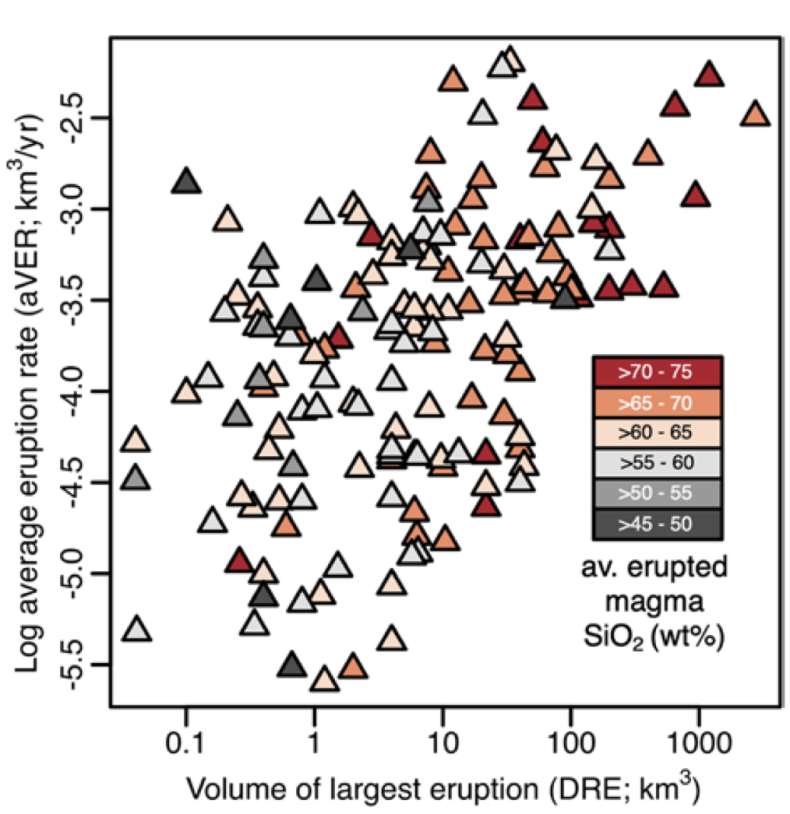
Volcanoes exhibit a wide range of eruptive and geochemical behavior, which has significant implications for their associated risk. The suggested first-order drivers of intervolcanic diversity invoke a combination of crustal and mantle processes. To better constrain mantle-crustal-volcanic coupling, we used the well-studied Lesser Antilles island arc. Here, we show that melt flux from the mantle, identified by proxy in the form of boron isotopes in melt inclusions, correlates with the long-term volcanic productivity, the volcanic edifice height, and the geophysically defined along-arc crustal structure. These features are the consequence of a variable melt flux modulating the pressure-temperature-composition structure of the crust, which we inverted from xenolith mineral chemistry. Mafic to intermediate melts reside at relatively constant temperature (981 ± 52 °C; 2σ) in the middle crust (3.5−7.1 kbar), whereas chemically evolved (rhyolitic) melts are stored predominantly in the upper crust (<3.5 kbar) at maximum depths that vary geophysically along the arc (6−15 km). Our findings are applicable worldwide, where we see similar correlations among average magma geochemistry, eruptive magnitude, and rate of magma input.