
Paroxysmal eruptions at basaltic volcanoes: A numerical investigation of the 2020–2022 paroxysmal sequence at Mt. Etna
La Spina G., Corsaro R.A., Miraglia L.
Abstract
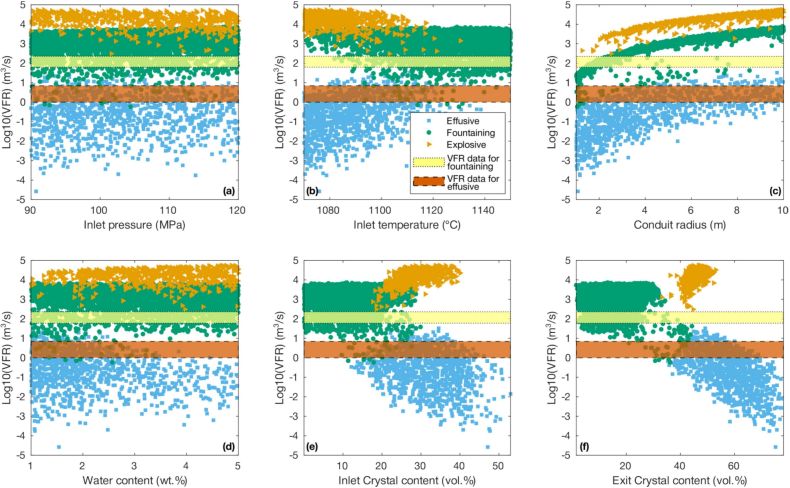
Between December 2020 and February 2022 a series of more than 60 paroxysmal events occurred on Etna. For this eruptive sequence, previous studies demonstrated that the evolution of magma composition was mostly driven by the mixing of a basaltic and trachybasaltic magma. To investigate the role of magma composition and of syn-eruptive conditions on magma ascent dynamics during paroxysmal activities at basaltic volcanoes, we performed a series of numerical simulations using a conduit model. Our data show that, across most of the investigated combinations of syn-eruptive conditions, both the more evolved trachybasaltic magma and the more primitive basaltic magma exhibit an equivalent style of activity. Thus, it is the different syn-eruptive conditions (i.e. pressure, temperature, volatile and crystal content) of the two end-members at the inlet of the conduit that mainly control the eruptive style and not just magma composition. Numerical results indicate that sustained fountaining activities of this paroxysmal sequence require a temperature at the inlet of the conduit (4 km below the vent) greater than 1090–1100 °C and an inlet crystal content lower than ~25 vol%. On the contrary, effusive eruptions in agreement with those observed during the 2020–2022 eruptions require an inlet temperature lower than 1110–1120 °C, a water content lower than ?3 wt% and an inlet crystal content greater than ~20 vol%. We also found the presence of critical viscosity values, that, when exceeded, result in a transition in eruptive style with a sudden increase in mass eruption rate of more than an order of magnitude. These transitional viscosity values are not influenced by the thermodynamic conditions of the magmatic system, but they are affected by conduit geometry, outgassing efficiency and timescales of crystallisation and ascent.