
Probabilistic scenario-based assessment of volcanic gas-dispersion hazard at Vulcano Island, Italy
Massaro S., Granieri D., Bisson M., Carapezza M.L., Diliberto I.S., Dioguardi F., Iacono F., Macedonio G., Paonita A., Ranaldi M., Ricci T., Salerno G., Stocchi M., Tamburello G., Tarchini L., Costa A.
Abstract
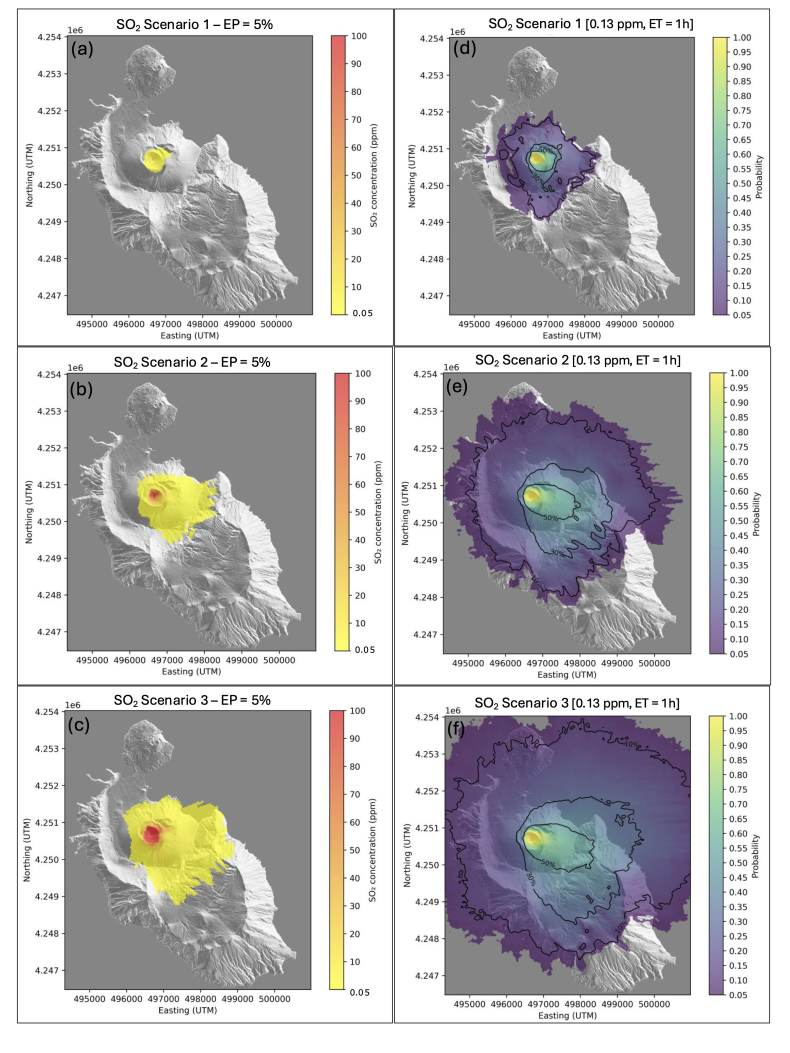
Introduction: Vulcano Island, in the Aeolian Archipelago (Italy), is affected by recurrent degassing crises during which elevated volcanic gas emissions may pose hazards to residents, visitors, and personnel operating in the active crater area. This study presents a scenario-based probabilistic assessment of outdoor CO2 and SO2 dispersion hazards at Vulcano. Methods: The assessment integrates long-term meteorological variability, geochemical monitoring data and numerical dispersion modelling. Three representative degassing scenarios were considered: (i) background activity, based on long-term monitoring data; (ii) unrest conditions, representative of the enhanced degassing observed during the 2021–2022 crisis; and (iii) an escalation scenario exploring the effects of a further increase in gas emissions. Atmospheric variability was represented by randomly sampling 1,000 days from 30 years of ERA5 reanalysis data, complemented by local meteorological observations. Hazard and persistence maps were generated using the VIGIL workflow, which couples passive and gravity-driven dispersion models. Results: The simulations indicate that SO2 represents the main outdoor gas-dispersion hazard across the investigated scenarios. Under background conditions, hazardous SO2 concentrations remain largely confined to the La Fossa crater area, whereas under unrest and escalation scenarios the affected area expands along the crater flanks and, under specific meteorological conditions, toward sectors frequented by visitors or located near inhabited areas. In contrast, modelled outdoor CO2 concentrations at 2 m above ground level remain below hazardous thresholds under background and unrest conditions, while elevated concentrations are predicted in the escalation scenario, particularly within the crater area. Discussion and Conclusions: Comparison with available monitoring data highlights the importance of poorly constrained local fumarolic and diffuse CO2 sources, particularly near Vulcano Porto and Levante Beach. Overall, the proposed probabilistic framework provides a quantitative basis for identifying areas where hazardous gas concentrations may occur or persist under variable atmospheric conditions, supporting future monitoring strategies and preparedness planning during degassing crises.