
3D resistivity imaging of Pantelleria Island for geothermal exploration
Isaia R., Sposato M., Troiano A., De Paola C., Gonzalez G., Di Giuseppe M.G.
Abstract
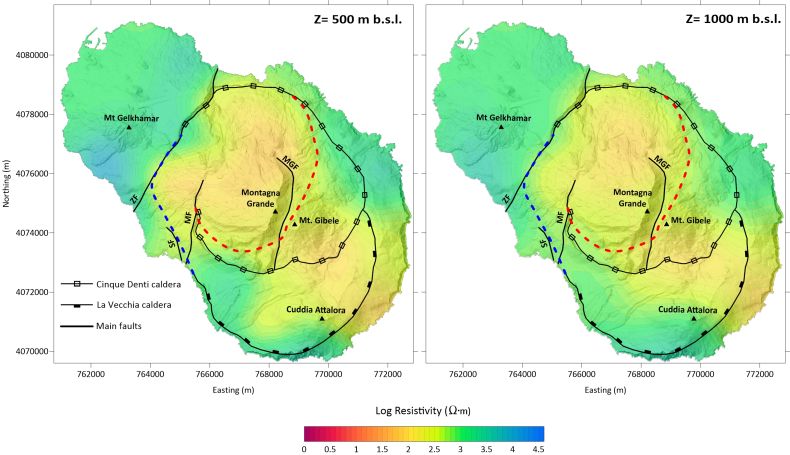
This study presents a geothermal exploration investigation of Pantelleria Island (Italy), characterized by an active caldera system and widespread surface hydrothermal manifestations. The research is based on the construction of a three-dimensional resistivity model derived from audio-magnetotelluric data which provides a detailed reconstruction of the subsurface electrical structure and its relationships with the main volcano-tectonic features of the caldera system, offering an integrated view of the active geothermal setting. The results show that these structures are spatially associated with changes in reservoir geometry and with the inferred pathways of deep fluid circulation, suggesting that they may locally act as barriers or preferential conduits for fluid ascent. A moderately resistive anomaly (β) delineates the main geothermal reservoir in the central-southern sector, with a potential fluids accumulation zone between 500 and 1000 m depth below sea level, consistent with well data indicating temperatures up to 250 °C at the same depths. In the northern pericaldera sector, a high-resistivity anomaly (γ) marks a cooler (<200 °C) area associated with mainly basaltic rocks and limited fluid circulation, while shallow high-resistivity levels (γ′) correspond to lava flows and domes. The 3D resistivity model also highlights highly conductive shallow layers (αanomaly), consistent with hydrothermal alteration and/or shallow fluid-rich levels, whose interpretation varies according to their geological and hydrothermal setting. It also enables estimation of the geometry, continuity, and volume of the geothermal reservoirs. These results offer new constraints for sustainable exploration, resource management, and future thermo-fluid dynamic simulations aimed at the quantitative assessment and development of the island's geothermal potential.